Author: Olivia Li
From July 27th to August 5th, I had the honor of participating in a 10-day summer camp organized by Zhejiang Agriculture and Forestry University, ZUAA-GWDC Foundation, and Capital Youth Outreach Club (CYOC). Nearly 30 students, including myself, were given the incredible opportunity to explore different parts of China. We visited bustling cities like Shanghai and Hangzhou, where swarming streets were filled with vendors, tourists, and the irresistible aroma of fresh food. We also experienced the charm of smaller and more rural areas such as Xiandu and Heyang Ancient House in Jinyun City. For someone like me, who had never been to China before, this was a priceless and memorable chance to connect with the unique culture and lifestyle of my motherland.
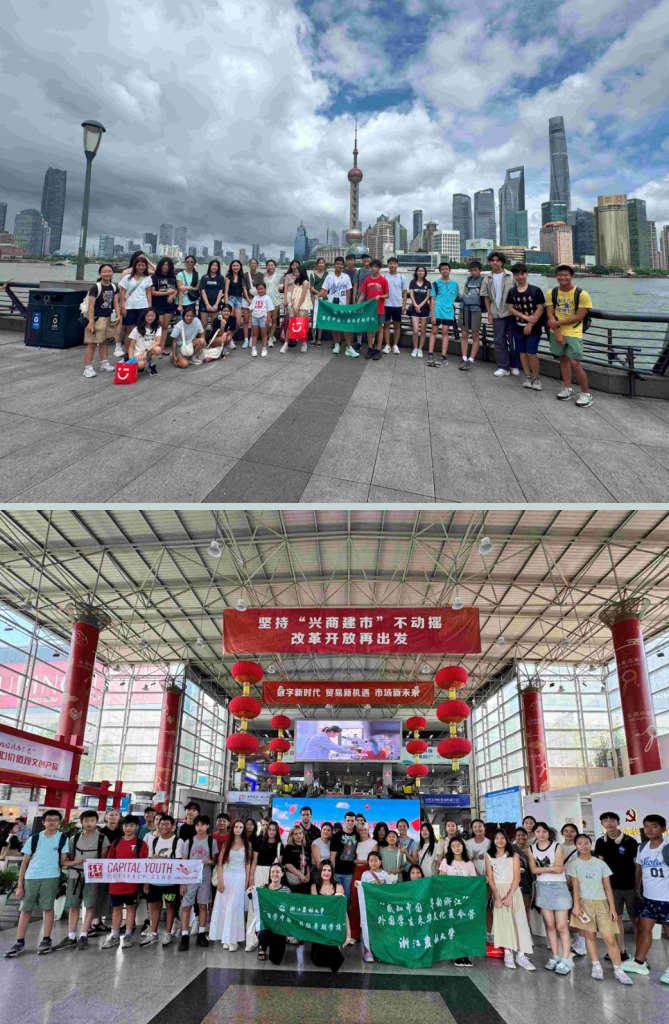
Our journey began in Shanghai, where we walked down Nanjing Road, often referenced as “China’s No. 1 Commercial Street.” Known as one of the busiest shopping streets in the world, it was lined with countless stores, dining, and entertainment options, comparable to Fifth Avenue in New York City, though with a distinctly Chinese essence. At the end of the road lay another well-known attraction: The Bund. This is Shanghai’s most iconic riverside promenade, famous for its blend of historic European-style buildings and modern, futuristic architecture. Among these buildings is the Oriental Pearl Tower, which is a skyscraper gleaming in shades of pink, gray, and white, a symbol of Shanghai’s rapid growth and development.
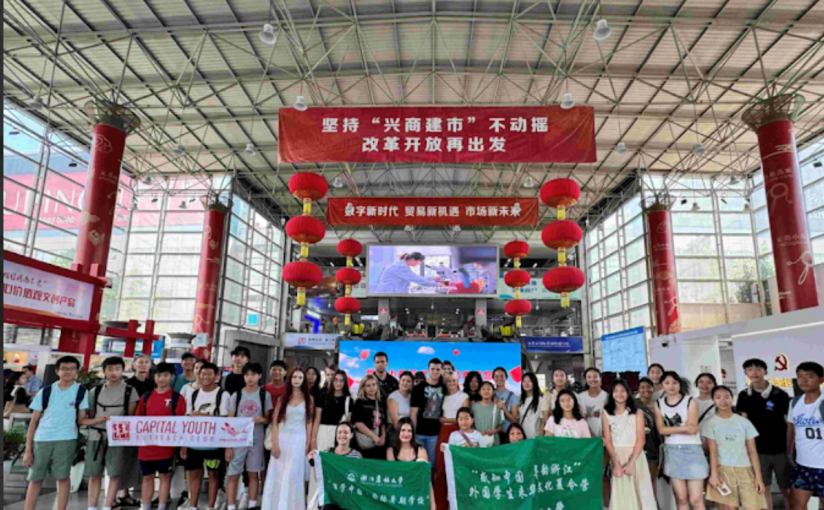
That night, we traveled to Yiwu, home of the world’s largest wholesale market. The market is split into five districts, each specializing in different goods. The scale of the market was overwhelming; it would take a full month to visit every shop there. From keychains to drones to furniture, everything seemed to be sold at surprisingly low prices. I even practiced bargaining—a skill common in China but rare in the U.S. Yiwu is truly a must-visit destination.
Our next stop was Jinyun, a region of breathtaking natural beauty and spiritual significance. Mountains surrounded ponds with crystal-clear ponds, where hundreds of koi fish swam. As we walked deeper into the park, we encountered a series of ancient temples lined up one after another, with the final temple housing a statue of the Yellow Emperor, a legendary figure in Chinese history. There, we enjoyed a traditional ritual performed by staff of the Xiandu Scenic Spot, which brought the culture vividly to life. In contrast to the beautiful scenery, the Heyang Ancient Residential Buildings housed a small village of people, mostly of the older generation. We toured their neighborhood and saw stone mills used to grind wheat, ancestral halls, and experienced the art of Chinese brush calligraphy.
The following day, we left Jinyun and drove to the Zhejiang Agriculture and Forestry University (ZAFU). Dean of International College of ZAFU, Professor Youhua Zhao, warmly welcomed us with an opening ceremony and introduced us to the university’s programs. The campus itself was stunning—beautifully maintained with vibrant flowers and greenery to create a picturesque image.
For the next four days, we explored Zhejiang Province. At Qingshan Lake Water Forest Park in Lin’an, we were surrounded by a forest of trees planted in the water, creating a serene and almost magical atmosphere. The end of the forest opened up to a river where the city skyline was visible at the other end and boats sailed by. In the afternoon, we went to the Lin’an Museum, where we saw ancient porcelain, particularly bowls and other artifacts that deepened our knowledge of historical craftsmanship.
One of the highlights of our visit to Zhejiang was touring the West Lake. A peaceful boat ride brought us to the central island, where we wandered through tree-lined paths and stands selling snacks, souvenirs, and merchandise from popular media. The view of the lake, filled with different types of boats cruising along and lilypads afloat on the surface was gorgeous. Later, we entered the historic Hefang Old Street. This was once again a boisterous and busy marketplace, some stores selling unique Chinese crafts like blown-sugar candy, tea, etc. Shopping there was fun and eye-opening, especially experiencing China’s fast and convenient digital payment systems.
The third day in Lin’an encompassed mostly indoor activities. At the Beijing-Hangzhou Grand Canal Museum, we discovered the history of China’s canal systems and their importance in trade and irrigation. Interactive games and quizzes made the experience both fun and educational. At the Shihushan Robotics Center of Zhejiang University, we were given a tour on some of the robots students were currently designing and trying to implement into today’s society. For instance, there were robot dogs that could do backflips and greet others on command, a ball-shaped robot meant to enhance security in public areas, a device to help with surgery, a charging implementation on electric cars, as well as a human robot. The difference between futuristic research and old traditional crafts showed me that China is a country deeply rooted in its past while simultaneously building its future.
On our final day, we returned to ZAFU for a closing ceremony, where several students including Ruichen Feng (CYOC), Tony Bu, Aiden Dai, Olivia Li (CYOC), Owen Wang, and Guo (Joy) Tang shared reflections on the trip before we gathered for a group photo. Ruichen said he was very impressed by the strong economy, advanced science and technology development, and rich historical culture. Olivia described the camp as a fun trip which gave her a great opportunity to experience the Chinese culture and history in multiple facets. Afterward, we made one last stop at the world-famous rural tourism town, Lu Village. There were many antique shops that sold handmade crafts like pottery, figurines, etc. It was a lively and colorful place that perfectly wrapped up our journey.
I am grateful to the teachers and sponsors from ZAFU for making this trip possible. I also want to thank Dr. Jun Zhao and Dr. Ping Lu (ZUAA-GWDC Foundation) and Professor Tao Chen (CYOC) for their hard work behind the scenes to plan such a wonderful trip for us. The few parent chaperones (Hao Li, Guoping Zhao, Chuanfeng Wu, and Liqun Zhao) also worked tirelessly to ensure that every child could make the most out of the experience by giving us plenty of opportunities to have fun beyond the itinerary.
Traveling across China offered me a deeper appreciation of its culture, from its busy cities to its peaceful villages, from its rich traditions to its technological ambitions. I returned home with a greater understanding of Chinese culture, everlasting memories, and lasting friendships. This trip will remain an unforgettable experience in my life.
Website Editor: Sophia Wang
 华府青年 CYOC
You must be logged in to post a comment.