Author: Albert Lu
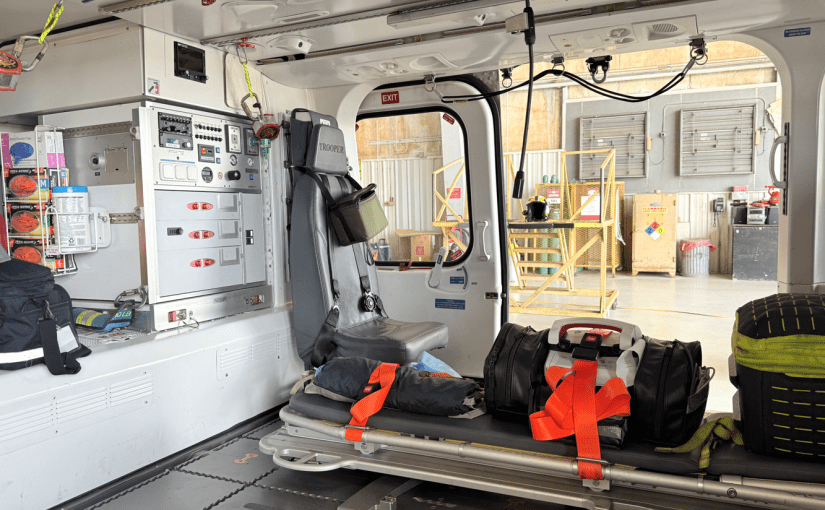
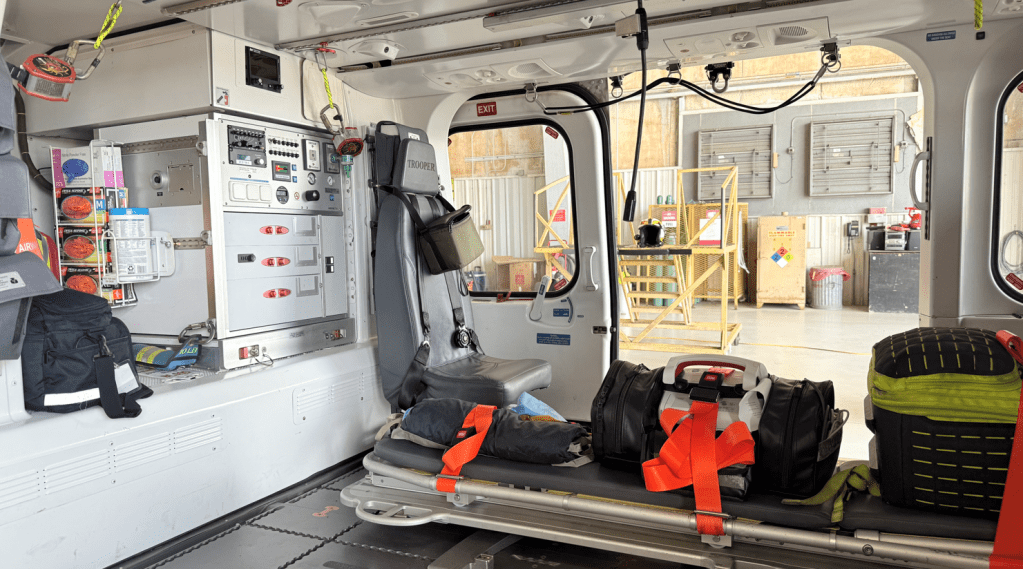
I was recently invited by Dr. Peter Hu, Professor of Anesthesiology, Surgery and Epidemiology, Chief Technologist of Maryland Shock Trauma Center, and director of the Precision Research in Medicine and Engineering (PRIME) AI Lab, to visit the Maryland State Police (MSP) Trooper 1 Barrack, one of seven helicopter stations across Maryland that are ready to provide medevac services on the call. The medevac center has offered me a profound glimpse into the critical world of Emergency Medical Services (EMS), particularly the sophisticated operations of helicopter transport.
Caption: The AW139 helicopter used by the MSP medevac services
I learned from Dr. Doug Floccare, the Air Medical Director and Emergency Medicine Physician for the state of Maryland, there about the absolute necessity of this network of helicopters. Based on Adam Cowley’s “Golden Hour” concept, which originated during the Korean War, a patient who has suffered severe trauma has the best chance of survival if stabilized within an hour. As Cowley put it, EMS is a race against time: if you aren’t transported to the place you need, you die. If the needed specialized materials for treating the injury doesn’t arrive in time you die. For me, this showed the true immediacy of EMS: although patients may not die on the spot in an hour, there will have been irreversible damage and death will follow soon. This network of helicopters is ready to reach any part of the state in under 25 minutes, even under 10 minutes in populated areas, and get to the proper hospital. The importance and readiness the troopers have for their job really brought me more appreciation for their actions and what they do in the skies every day.
Later, one of the pilots described to us the importance of the helicopter network throughout Maryland. I occasionally saw helicopters in the sky, but I never thought about the work that was occurring on-board, over 1000 feet in the air. The program has saved over 200000 lives from its inception in 1958, nowadays averaging 2000 lives saved per year. The huge scale of their work really moved me, seeing firsthand their impact on the lives of the people of Maryland. Furthermore, he recounted stories in other states how parents refused to let their children be transported by helicopter because they couldn’t afford the 60000 it would cost. In Maryland, however, the MSP helicopter service is funded by the state, and as they put it, “nobody is going to be scared, when they see an MSP helicopter above them, because they know it’s all paid for.”
The pilot told his origin story about how he was run over by a truck and was rescued by an MSP helicopter. Now, he is out there saving lives via the same program that saved him. I saw firsthand the rigorous training, cautious inspections, and readiness for action that exemplified how prepared they are for these medevac operations. I felt the profound sense of responsibility, the relentless pursuit of saving lives, and the dedication that they carried with them everyday to provide these high-quality services without billing the patients. This visit instilled a deeper appreciation in me for the unsung heroes who work tirelessly behind the scenes, ensuring that critical care is always within reach for those in dire need.
Website Editor: Sophia Wang
 华府青年 CYOC
You must be logged in to post a comment.