
By Capital Youth Outreach Club (CYOC) Member: Ruichen Feng
This summer, as members of the Capital Youth Outreach Club (CYOC) and passionate STEM enthusiasts, my friends Evan Chen, George Wang, and I decided to give back to the community by organizing a free STEM enrichment program focused on 3D printing, electric circuits, and Arduino programming. With experience in these areas—mine in 3D design and printing, Evan’s in electronics and programming, and George’s in robotics—we felt confident that we could create a fun and educational experience for younger students. We named it the CYOC Summer Engineering Workshop, and it brought together 15 curious and creative middle schoolers for a week of hands-on learning and innovation.
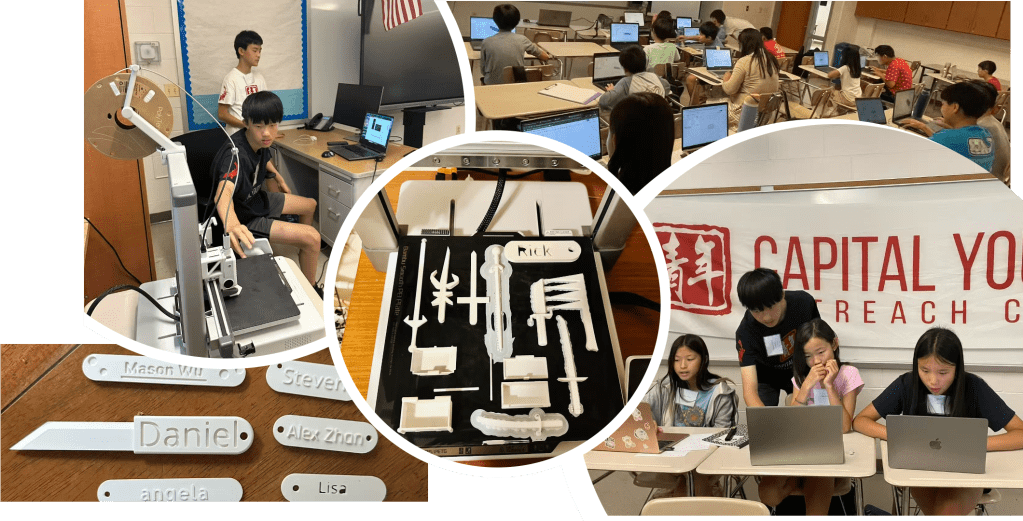
My primary responsibility was teaching 3D design and printing using Onshape, while Evan led the instruction on electric circuits and Arduino programming. As the Onshape instructor, one of the biggest challenges I faced was pacing. Onshape is a powerful 3D modeling and CAD tool, but it can be tricky for beginners—especially younger students—to grasp. At the same time, some students had prior experience and could finish the basic lessons in just a few hours. Finding a balance that supported beginners while still challenging more advanced learners was no easy task.
We kicked off the first day by introducing students to Onshape basics like sketching, extruding, and assembling. Their first project was designing personalized name tags—a fun and rewarding way to bring their digital work into the physical world right away. From there, students advanced to more creative designs such as swords, cups, bells, and eventually a treasure chest. Each project built on the previous one, gradually increasing in complexity. Seeing their designs come to life on the 3D printers was incredibly motivating—many campers eagerly asked for their next project to be printed.
After wrapping up the Onshape portion, we transitioned to Arduino—a segment that quickly became the highlight of the week. Over the next three and a half days, students learned to wire circuits, connect sensors, and program interactive electronic systems. Their first Arduino project was a simple blinking light controlled by a button, which introduced them to basic wiring and user input. Next, they built a musical instrument using potentiometers (dials), servos, and a buzzer—learning how various components interact within a circuit.
The final and most exciting project was building a small car that could detect and avoid obstacles using a distance sensor. This challenge combined coding, sensors, and motors, allowing students to see how real-world technologies come together to solve problems. George’s help with this project was incredibly valuable—his background in robotics allowed him to assist students more deeply and troubleshoot complex issues with confidence.The final day of camp was reserved for finishing touches and preparing for a student exhibition. After a nice pizza lunch which Danial Guo’s family donated to our workshop, every camper completed their Arduino project and proudly presented their work to their peers, parents, and CYOC advisors. Watching them explain how their creations worked—and seeing their excitement and pride—was one of the most rewarding moments of the entire workshop.
Reflecting on the week, I was truly impressed by how quickly and enthusiastically the students embraced challenging tools like Onshape and Arduino. Their creativity and determination were inspiring, and I have no doubt that many of them could become the engineers and designers of the future.Another key takeaway from this experience was the value of teamwork. Collaborating with Evan and George made the entire workshop not only more manageable but also more enriching. We each brought our own strengths—whether in CAD, programming, or robotics—and combined them to create a well-rounded, engaging learning experience for the campers. We constantly communicated, divided tasks efficiently, and supported each other when unexpected issues came up. This teamwork reminded me how powerful collaboration can be, especially in STEM, where sharing knowledge and working toward a common goal can lead to incredible results. Importantly, this workshop was offered completely free of charge, ensuring that every student—regardless of background—could participate. We strongly believe that opportunities like this should be open to anyone with curiosity and a passion for learning.
Of course, none of this would have been possible without the incredible support from our parents and the CYOC community. Evan’s mom, Dr. Fanyuan Wen, played a key role in preparing instructional materials and sourcing hands-on project supplies. Several other parents volunteered their time daily to help in the classroom, ensuring everything ran smoothly. We’re also especially grateful to our CYOC adult advisors, Dr. Ping Lu and Dr. Tao Chen, who visited the workshop to offer encouragement and celebrate the students’ achievements. Dr. Ping Lu’s presence on both the first and last days of the camp meant a great deal to us—it was a meaningful show of support and motivation.
In the end, the Capital Youth Outreach Club Summer Engineering Workshop was more than just a success—it was a truly unforgettable experience that sparked creativity, confidence, and curiosity in everyone involved.
Website editor: Conner Gauthier
 华府青年 CYOC
You must be logged in to post a comment.